

ClickHouse Newsletter
Hello and welcome to another ClickHouse newsletter!
We’ve got another feature-packed ClickHouse release, with custom HTTP handlers, pipelined SQL, and Japanese/Chinese tokenizers for the text-index.
Elsewhere, Mohamed Hussain S dives into the replication queue, Tom Schreiber and Lionel Palacin share the first end-to-end results from CostBench, and Himanshu Pandey walks us through reading ClickHouse query plans.
We also have preview releases of PromQL, On-Demand Compute, AI functions, and sub-second Postgres replication to ClickHouse
Inside this issue
Featured community member: Rory Shanks
This month's featured community member is Rory Shanks, ClickHouse Engineer at PostHog.
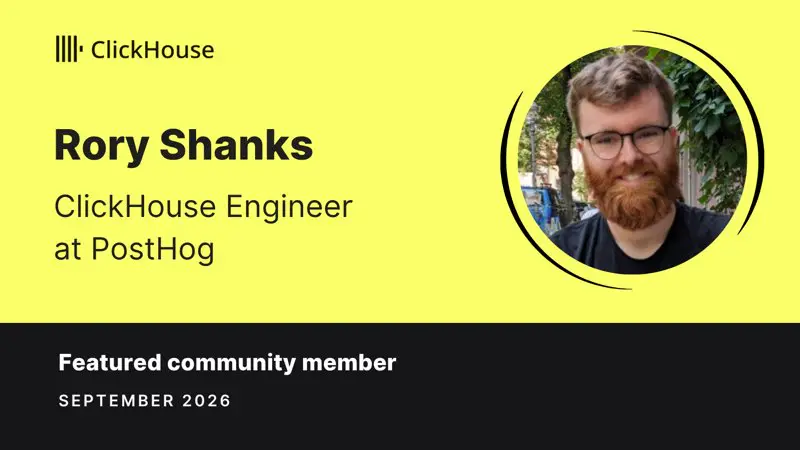
Rory’s background is in site reliability and cloud platform engineering, and he previously worked as a Staff DevOps Engineer at ENWAY and a Senior Site Reliability Engineer at Inkitt and powercloud.
Rory contributed several improvements to ClickHouse 26.8, released at the end of August.
First, he added an option for replicas to fetch already mutated data parts from another replica, avoiding the need to repeat mutation work locally. Additionally, he added caching for tokens absent from the text index and improved JSON subcolumn reads by reusing column metadata during conversions.
➡️ Connect with Rory on LinkedIn
Open House Roadshow
We’re halfway through the Open House Roadshow, but there are still visits to come in Bangalore (Sep 22), London (Sep 30), and Munich (Oct 6), so don’t forget to sign up!
➡️ See all Open House locations
26.8 release
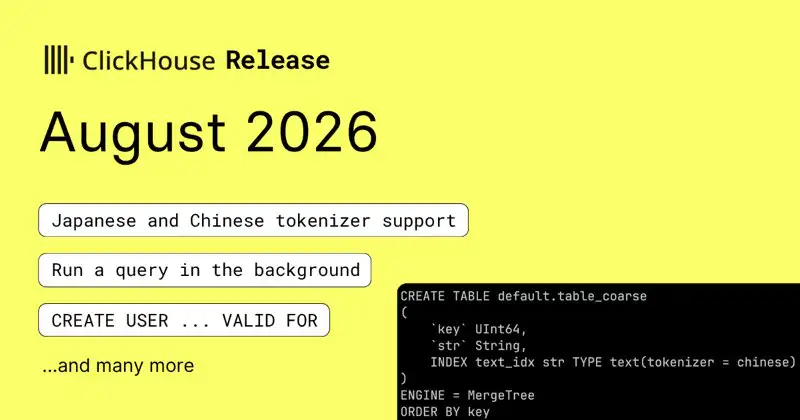
After last month’s mega 26.7 release blog post, we’ve decided to try something different this month: multiple smaller posts!
The 26.8 release includes a series of features, such as custom HTTP handlers and dynamic query filtering, that enable you to use ClickHouse as a streaming HTTP API. This release also adds a new |> operator that lets us write queries as a sequence of transformations.
The release also adds a system.user_query_log table that shows only the current user’s queries, a URL database engine, and Japanese and Chinese tokenizer support for the text index.
➡️ Read the release post
Understanding the replication queue in ClickHouse
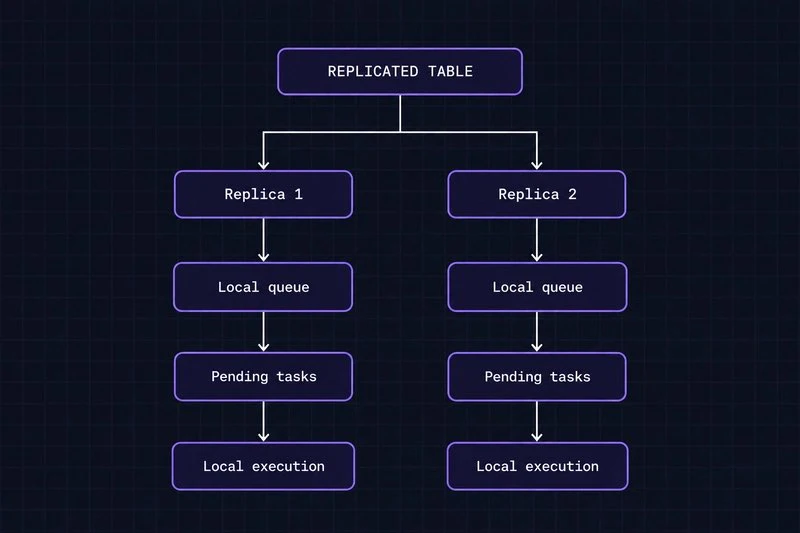
Mohamed Hussain S explores ClickHouse’s replication queue by stopping a replica and investigating the backlog.
He shows how to use the system.replicas and system.replication_queue system tables to diagnose issues, and explains why a non-empty queue doesn’t necessarily mean something is wrong.
➡️ Read the blog post
Measuring real-time performance per dollar under continuous load: CostBench’s first end-to-end results
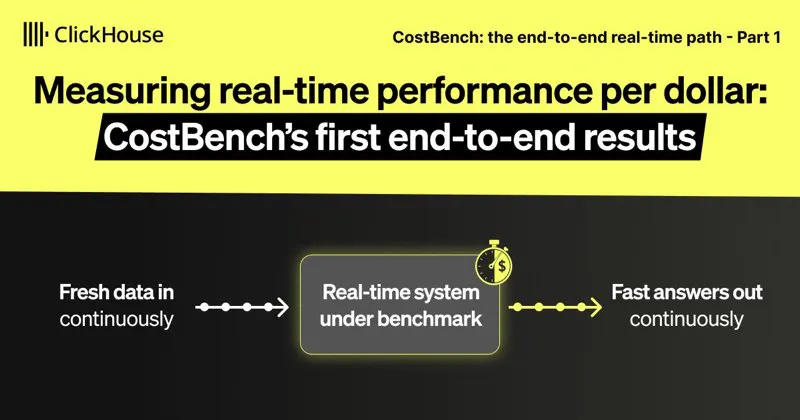
Tom Schreiber and Lionel Palacin share the first end-to-end results from CostBench, an open benchmark for cloud data warehouse cost-performance: performance-per-dollar, rather than just speed.
They test ClickHouse Cloud, Snowflake, BigQuery, and Redshift Serverless under continuous ingestion, measuring the cost of keeping fresh data ready for queries alongside query performance.
In a follow-up post, they take a closer look at the ClickHouse Cloud and Snowflake results, explaining how their architectures and billing models contribute to the performance-per-dollar gap.
➡️ Read the blog post
Announcing On-Demand Compute: Instant compute for your most intensive workloads
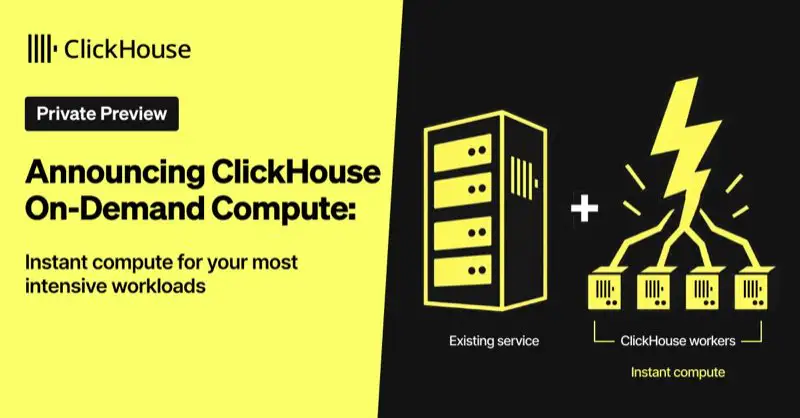
This is one of the biggest features we have been working on: On-Demand Compute is now in private preview.
You are now a step away from offloading intensive workloads to dedicated ClickHouse workers. And it doesn’t land alone! It comes with two friends:
• A new cost-based optimizer (CBO)
• A new distributed query execution framework
The dream for anybody wanting to offload ad-hoc or data lake queries to dedicated workers!
Curious to learn more? Melvyn Peignon will present a live webinar on September 24th, where he’ll explain how it works, give a live demo, and talk through the six-month roadmap.
➡️ Read the announcement
ClickHouse 26.8 LTS: 57 Breaking Changes Since 26.3
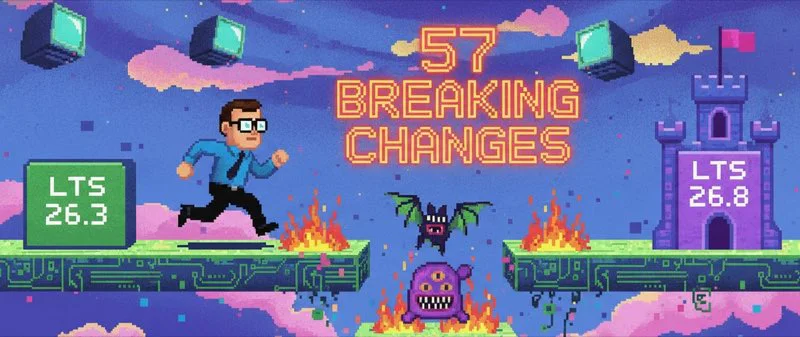
Mohamed Hussain S has written an alternative blog post for the 26.8 release, exploring changes since the previous LTS release, 26.3.
He highlights breaking changes and new defaults across all five releases, with a checklist of what to audit before upgrading and monitor afterward.
➡️ Read the blog post
Postgres Round-up
We’ve been publishing more and more Postgres content as the weeks go by, so I thought it deserved its own section in the newsletter.
- Sai Srirampur announced WalShadow, an open-source engine that replicates Postgres data to ClickHouse directly from the physical WAL. It’s available as an open-source project or in private preview on ClickHouse Managed Postgres.
- Kunal Gupta announced the availability of ClickHouse Managed Postgres on Google Cloud, also in private preview for the time being.
- David Wheeler announced the open-source chdb Postgres extension, which expands Postgres import and export features via the chDB library.
- Gülçin Yıldırım Jelínek has started writing a series of blog posts on Postgres 19. So far, she’s covered monitoring, new system views, and read-your-writes.
- Kaushik Iska explains how ClickHouse Managed Postgres protects Postgres from resource-hungry supporting processes.
- Sai Srirampur explores how storage choices affect Postgres performance.
- Cristina Albu and Yashpreet Bathla walk through a new onboarding flow for ClickHouse Managed Postgres.
Introducing ClickHouse's new TimeSeries Engine: Your drop-In Prometheus replacement
James Cunningham introduces PromQL and the TimeSeries table engine in ClickHouse Cloud, now in private preview.
You can send metrics to ClickHouse through Prometheus remote write and query them with PromQL in Grafana, ClickHouse, or ClickStack, all while keeping your existing collection setup.
➡️ Read the blog post
Quick reads
- Saarth Soni compares streaming and batch counts of Wikipedia edits using Quix Streams and ClickHouse, exploring why the same data can yield different results.
- Oleksandr Andrushchenko compares ClickHouse and PostgreSQL for SMS analytics, reporting that ClickHouse processes 10 times more rows and exploring how query shape affects performance.
- Himanshu Pandey explains how to read ClickHouse query plans to understand query execution and investigate performance.
- Andriy Yakovlev and George Larionov introduce AI Functions in ClickHouse, bringing AI models into SQL for tasks such as text generation, classification, and embeddings.
- Pete Hampton shows how to build semantic search with Google’s MCP Toolbox and ClickHouse, automatically turning text into embeddings for storage and search.
- Lareb Zafar introduces ClickGap, an autonomous QA agent that tests merged ClickHouse changes and traces regressions to the commits that introduced them.
Upcoming events
Global virtual events
Virtual training
Events in AMER
Events in EMEA
Events in APAC
ClickHouse Inc., 650 Castro St. Ste. 120 Unit 92426, Mountain View, CA 94041, USA. We value your feedback. To unsubscribe from our emails, click here.